
Africa's Hunting Party - African Wild Dogs
Discover the most effective hunter in Africa.
3/6/20264 min read
“Hurry up, you don’t want to be late,” your dad yells as you walk out of your room at the resort. As you walk outside, it's a perfect 80-degree day without a single cloud in the sky in the Kruger National Park in South Africa. You follow your parents to a large truck with a ladder on the back. As you climb up the ladder, you see a strange-looking man in the driver's seat. The man is barefoot with green camo swimming shorts, a blue button-down fishing shirt, and a red, white, and blue cowboy hat.
“Hello, everybody. My name is Professor Professor Wild, and I will be your tour guide for the day. Yes, I am a professor, and yes, my name is also Professor.” The man says. “If everyone is ready, let's go visit a family I've been studying recently.” “I thought we were supposed to be finding wild animals. Why are we going to visit a family?” You ask. “Don't you worry, my dear child.” Professor Wild replies. “We’re not just going to look for animals, we're going to find some of my favorite animals.” The truck starts up, and you head off into the African wilderness.
As you drive, you see lots of animals such as zebras, wildebeests, antelopes, buffalo, and elephants, to name just a few. Then, after a couple of hours, the truck stops out of nowhere. You’re pushed into the seat in front of you, you would have hit it too if you weren't wearing your seatbelt.
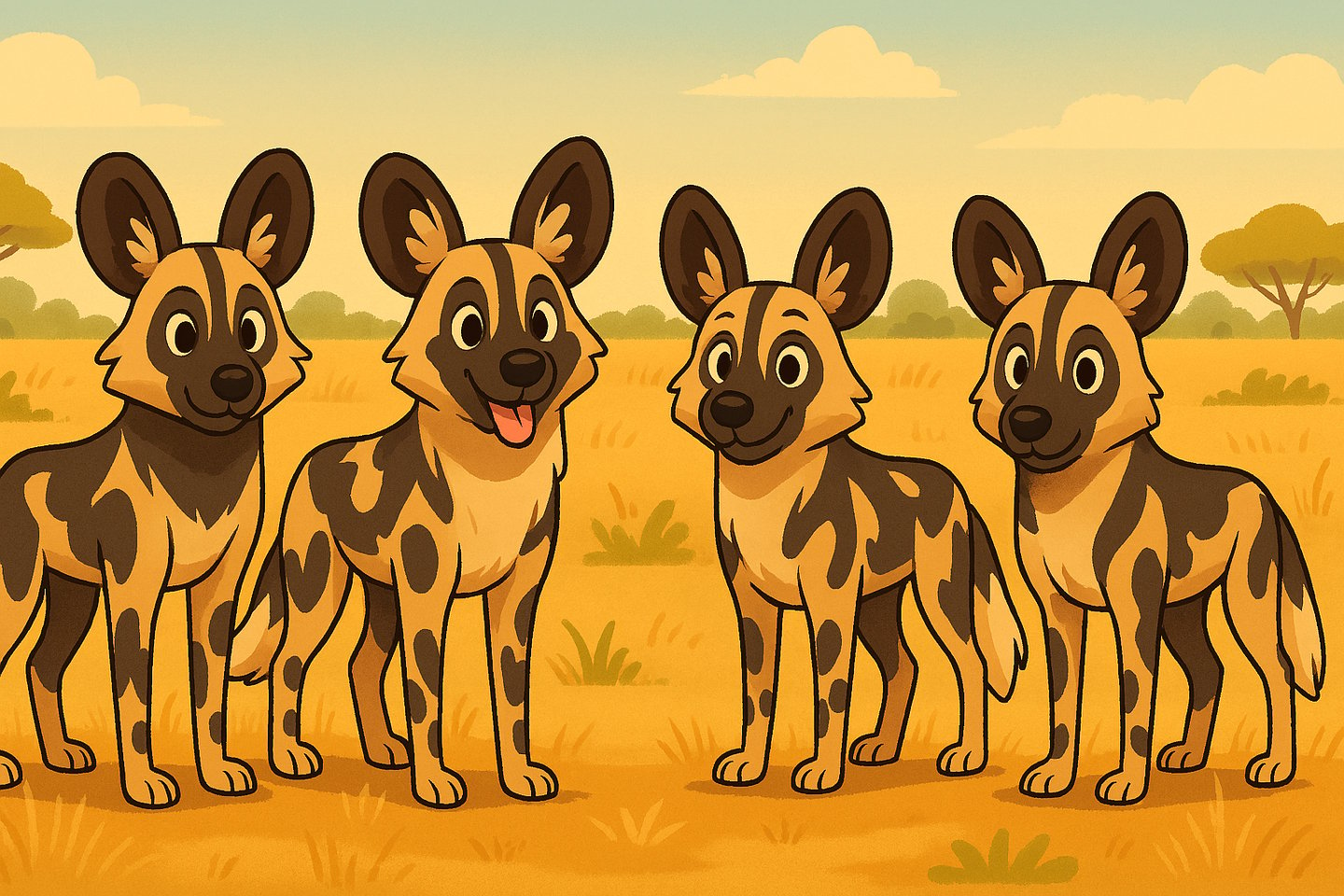
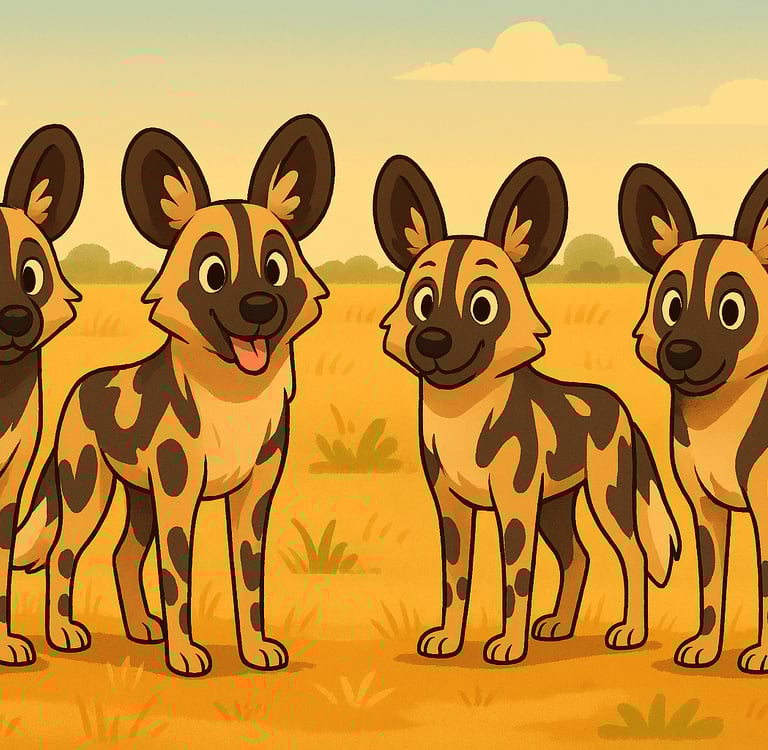
“We’ve made it.” Professor Wild says. You look off the side of the truck to see what Professor Wild is talking about, and you see… nothing. You see some bushes to your left, and you see some big rocks to your right, and a whole lot of brown dirt in between, but you don’t see any animals. You look harder, and still you see nothing. Then, like magic, you see six dogs running out of the bushes. They're tall and skinny, and even though they are all brown, white, and black, none of them look alike. Each of them has different markings and spots. They look like someone took a brown dog and randomly threw white and black paint on it.
Then, from the rocks, you see another adult dog with around ten puppies following it. You watch as the adults meet up with the puppies.
“Everyone, I'd like to introduce you to the African Wild Dog.” Professor Wild says. “So, Professor, what are we looking at? What are these dogs doing?” Your dad asks. “The adults are getting back from a hunt.” Professor Wild replies. “Something I personally find very interesting about these animals is that they might not have the strength of lions, or the speed of cheetahs, but despite that, African Wild Dogs are the best hunters in all of Africa. Family is everything to these animals, and as a result, they work extremely well together. They don't do quick hunts as cats do; instead, they have one of the dogs chase their prey, and once that dog starts to get tired, it gets replaced by another dog until their prey is too tired to run anymore.”
You look back at the dogs that now look more dangerous and impressive than they did just a minute ago. You swear that one of the dogs is looking straight at you. Something about it is strangely comforting; it reminds you of your dog back home. Only this dog just got back from hunting another animal, and your dog doesn't eat anything that doesn't come out of a bag.
As you look, you notice that one of the adults is throwing up. You wonder if the dog is sick or if it ate something bad. Then Professor Wild tells you, “African Wild Dogs are not strong enough to carry their food back to the den, and they chase their prey long distances that would make it nearly impossible for them to carry it back with them. But these animals have their own special way of solving this problem. If you pay close attention, you will notice that the hunters are now regurgitating some of their food for the pups and babysitter to eat.” You gag a little at the thought of the puppies having to eat vomit.
“How did these dogs all come together to create this pack?” a man from your tour asks. “They’re family,” the Professor replies. “Every pack starts with just two, the alpha male and female. Those first couple of years are the hardest. At first, they only have each other to help hunt, but once the female gets pregnant with the first litter, things get even harder. Once the female can't go on hunts anymore, the male has to do all of the hunting by himself and still has to get enough food for himself, his mate, and any pups they have. By the time of the second litter, the male has help, but it still isn't easy because the older pups who are now going on hunts are still learning how to hunt and can cause a hunt to not be successful. Over the years, some of their pups will leave to go find a mate of their own and start their own pack, and some of the pups will always stay with the pack.”
“Wow, my life is easy,” you think to yourself. “I don't have to hunt for my food or someone else's food. I don't have to teach someone how to hunt or learn how to hunt to be able to eat. And best of all, I don't have to and never have eaten someone else's vomit.”
“Seatbelts on!” yells Professor Wild. “Next stop, the Wild Dog's most hated enemy.” With that, you hear the backfire of the truck and are thrown back into your seat as Professor Wild slams on the gas. As you head off, you turn back one final time to get one last look at this amazing animal you didn't even know existed.
Fun Facts
African Wild Dogs are also called Painted Dog, Painted Wolf, Cape Hunting Dog, African Hunting Dog, Ornate Wolf, and Painted Lycaon.
African Wild Dogs mate for life.
The life expectancy of an African Wild Dog is 10-12 years.