
Africa's hunting Party - Cheetahs
A quiet morning on safari becomes unforgettable when Professor Wild steps into the savanna to greet a coalition of cheetahs he helped save. Join the adventure as you learn how these incredible cats survive, struggle, and form lifelong bonds.
3/27/20264 min read
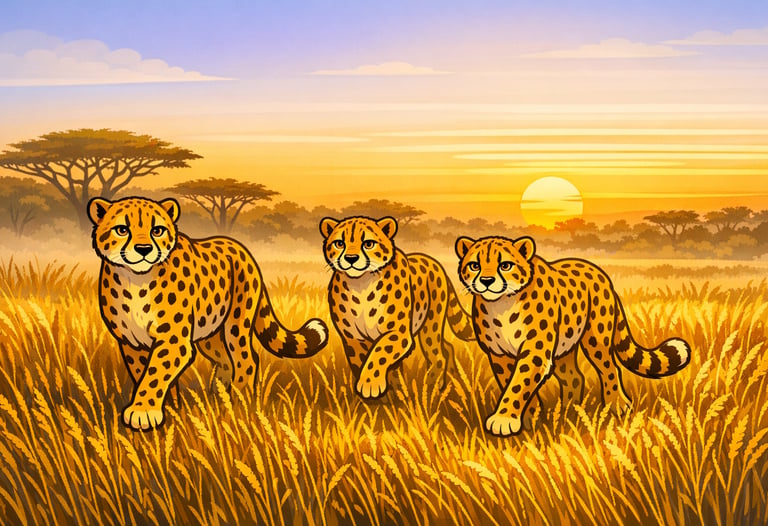
"Wake up! Wake up! Hurry! Everyone, wake up! You're going to miss it!" you hear in your dream. "That's weird," you think to yourself, "Why am I telling myself to wake up?" Your eyes shoot open as you realize those words aren't coming from your dream. You immediately notice that the sun is now up, and there is a slight fog lifting off the ground. It must be morning.
You see Professor Wild running down the aisle of the truck, frantically trying to wake everyone up. It's at this moment that you notice the truck is parked and turned off. "Is everything okay?" you ask Professor Wild. "Better than okay," he replies, "but we have to get everyone up before they miss it." "Before they miss what?" you ask in excitement. "Some brothers that I helped rescue and raise to be able to go back into the wild," he replies frantically. "We weren't planning on seeing them, but when I noticed them, there was no way I could just keep going."
You look off the side of the truck, but you see nothing but grass. "What did he see?" you wonder. You haven't known Professor Wild for long, but you've already learned that if he says something is there, that means something is there, and he will show you when he wants and how he wants.
You turn to your parents, who are the last ones still asleep on the truck. You start shaking both of them at the same time as you yell, "Wake up! Professor Wild has something for us to see!" As they wake up, you look to see where Professor Wild is and notice that he is at the back of the truck. "What are you doing?" you ask. "I'm going to say hello to some old friends. You guys stay here." And with that, you see Professor Wild climb over the back of the truck and down the ladder into the African savanna.
You watch nervously from the top of the truck. You have already learned about some of the most dangerous animals that nobody would be able to defeat or outrun. And now you're watching Professor Wild go to where those same kinds of animals are without you knowing what animal he sees. All you know is that there is more than one.
Then you spot something moving in the grass. It's heading toward Professor Wild. Then you see the spots. "It's leopards!" you shout. "Not quite," Professor Wild corrects. "I would never do this with leopards unless one needed to be rescued, and even then, we tranquilize them first. Also, leopards are never group animals. No, these are a coalition of cheetahs. Cheetahs that trust me because they have known me for years now, and cheetahs that I trust because I have known them for years and know how cheetahs naturally behave."
You watch as a cheetah comes to Professor Wild and rubs his head on him like a house cat might do. Then you notice two more cheetahs coming over to Professor Wild. You watch as one of the cheetahs licks Professor Wild's arm, and you see Professor Wild's face grimace a bit. "They're hurting him!" you yell in a panic. "It's okay," Professor Wild reassures. "They're licking me out of affection, like your dog or cat at home might do. The only difference is that cheetahs have very rough tongues."
"You said you rescued these cheetahs?" your dad asks. "How did you rescue them?" "It's a sad story," Professor Wild responds, with a tear coming to his eye, then quickly licked away by one of the cheetahs. "Their mom was killed by a farmer who was scared they were going to kill his animals. The cubs were then sold into the pet trade. A lot of cheetah cubs that are sold don't survive, but we were fortunate enough to be able to find these three and take them back to an animal rescue, where we got them healthy again and started training them to survive on their own. This is a huge problem for cheetahs, whose global population is believed to be less than 7,500, with roughly 200 here in Kruger National Park."
"That's terrible," your mom responds. "What are we able to do to help?"
"The best thing is to get people to see cheetahs for how they really are. They might be very good hunters, being successful on roughly 50% of their hunts. But they're also an animal that has a lot of struggles. For example, did you know that lions and hyenas take a cheetah's kill 10 to 15% of the time? They're also much sweeter animals than most people think, as you can see. But did you know that a lot of zoos will put a dog in with a cheetah to help with the cheetah's anxiety, and the dog and cheetah become extremely close friends? Or that females only have themselves to rely on while they have to hunt enough for themselves and their cubs while keeping their cubs safe from predators? Meanwhile, the males are very social and form the kind of coalitions that you see today. They are typically three male cheetahs who do everything together, but I have seen groups as big as five."
"Did you expect to see them?" your mom asks. You roll your eyes, knowing that Professor Wild had already said we weren't planning on seeing them, but then you remember your mom was still asleep when that conversation happened. "No," Professor Wild replies. "I didn't expect to see them, but I also wasn't that shocked. You see, cheetahs prefer to be active at sunrise and sunset. That isn't to say you won't see them at different times of the day, but that is when they are most active. In fact, it wouldn't shock me if they go hunting here soon."
As soon as Professor Wild finishes that statement, you see the cheetahs start to walk away in the direction of a herd of antelope. "Well, I guess that answers that," Professor Wild says as he climbs back into the truck.
Professor Wild gets back into the driver's seat of the truck. "Next stop: the resort," he says, a little more somberly than normal. You put your seatbelt on as you head back to the resort just in time for breakfast.
Fun Facts
Cheetahs don’t roar — they chirp!
Instead of roaring like lions, cheetahs make high‑pitched chirps that sound a lot like birds.
Cheetahs are the only big cats that can’t retract their claws.
Their claws stay out all the time to help them grip the ground when they run super fast.
A cheetah’s tail works like a steering wheel.
They swing it side to side to help them turn quickly while chasing prey.