
Africa's Hunting Party - Lions
Discover Professor Wild’s thrilling lion adventure as kids learn how coalitions form, kings rise, and wildlife stories come alive through fun, narrative learning.
3/13/20264 min read
You feel the wind rushing through your hair as you fly down the dirt road. When you look behind you, all you see is a brown cloud of dirt. To your right and left, bushes and yellowish‑brown grass blur together. It’s almost sunset now, and you can see the sun getting lower in the sky to your left.
Then you hear someone yell, “Heads up!” You look forward just in time to see an American‑flag cowboy hat land in your lap. You hold onto the hat, knowing there is no safe way to return it at this moment.
“What do you think we’re going to see?” you ask your mom.
“I don’t know, but I think your dad is going to be sick,” she replies.
“Brace yourself!” yells Professor Wild from the front of the truck as he slams on the brakes. You’re flung forward into your seatbelt as the cowboy hat that was on your lap goes flying toward the front of the truck.
“So that’s where that went,” Professor Wild exclaims as he catches his hat out of the air. The truck shuts off, and for a moment everything is quiet.
“What are we learning about at this stop?” you ask, excitement bubbling up as you think about the Wild Dogs you saw just a few hours ago.
“We are visiting a pair of brothers I’ve been watching for a while,” Professor Wild responds, tipping his hat.
“What do the brothers look like?” your mom asks.
Professor Wild points toward the front right of the truck. “Why don’t you see for yourself.”
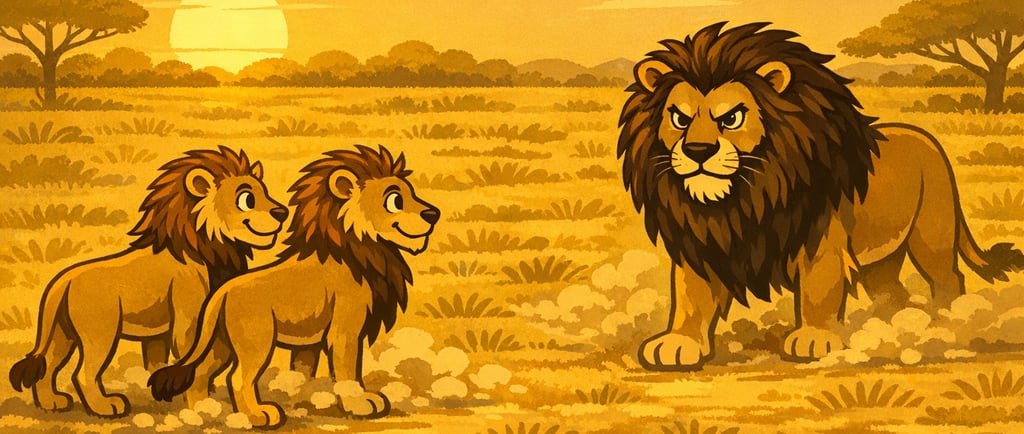
As you look, you see two of the most majestic animals you have ever seen. Two large, golden‑brown cats are walking in your direction. You don’t have to be told what they are this time — you recognize lions, the kings of the jungle. You notice they don’t have as much hair as you’ve seen in movies.
“This is my band of brothers,” Professor Wild says. “Or at least that’s what I like to call them. Technically, they are a coalition of nomadic lions. They aren’t yet at peak maturity, which is why their manes might not look like what you’d expect — but they’re close, and they’re very dangerous.”
“Where’s their family?” you ask.
“You’re looking at it,” he replies. “Male lions are forced out of their pride whenever their father thinks they might become a threat, usually around two or three years old. If they’re lucky, like these brothers, they’ll have one or more siblings forced out at the same time. They then form a coalition that will do everything together for their entire lives. Until they manage to take over a pride of their own, they are all the family they have.”
“How do they do that? Take over a pride, I mean,” your dad asks.
“I think you might get the chance to see for yourself,” Professor Wild replies. “We are currently in the territory of a dominant lone male who has been over the local pride for about five years now.”
As soon as Professor Wild finishes speaking, you hear one of the deepest sounds you’ve ever experienced come from behind you. You don’t just hear the roar — which makes your ears ring — you feel it in your chest. It feels like you just got hit in the back.
You turn around slowly. You know you’re safe, but you’re still scared to see what could make that noise. When you finally look, you see the biggest cat you have ever seen. You gulp in panic as you stare at the most majestic and terrifying creature you’ve ever encountered — a lion with a dark, full mane that looks soft enough to use as a pillow.
You watch as the lone lion walks confidently past the truck as if it doesn’t even exist. The lions size each other up, and then one of the brothers crouches down to pounce on the older male.
Before you can see what happens next, everything goes black, and you get a strong whiff of campfire smoke.
“There’s nothing here a kid needs to see,” you hear Professor Wild say as you realize he has just put his cowboy hat right over your face to block your view of the fight.
You can’t see the fight, but you can hear the deafening roars and growls. You hear a gasp — probably from your mom. And then finally, you hear Professor Wild say, “Well done, boys! Congratulations!”
For a brief few seconds, everything goes silent. Professor Wild lifts his hat off your face and puts it back on his head with a huge smile.
“What just happened?” you ask.
“What just happened is the brothers just became kings!” Professor Wild says proudly. “They won the fight and have earned themselves their very own pride.”
“And the other lion is okay?” you ask, concerned for the massive creature you saw just minutes ago.
“Relatively,” Professor Wild replies. “He will most likely live out the rest of his life as a nomad. Life won’t be easy for him, but it looks like he managed to get out of the fight without any injuries. That’s better than a lot of lions can say.”
“So what happens now?” you ask.
“What happens now for these brothers is they will go take control of the pride and start patrolling their new territory,” Professor Wild explains. “But we don’t need to see that. What’s next for us is we are going to see the most villainized animal in all of Africa.”
Fun Facts
Only one lion species lives today, but it includes two surviving populations: African lions and Asiatic lions, the latter now numbering about 891 individuals in India after a major recovery effort. Extinct relatives like the Barbary, Cape, American, and Cave lions once roamed across Africa, Europe, Asia, and North America.
A lion pride is usually about 15 lions, made up of related females, their cubs, and one or a few males. Some prides can grow to more than 30 members when food is plentiful.
Lions succeed in only about 15–30% of their hunts, missing more often than they catch. They hunt best at night and when working together as a group.