
Professor Wild: Expedition Mediterranean - Part 1
Join Professor Wild on a high‑speed research adventure across the Mediterranean Sea, where every wave hides a new surprise. What begins as a simple jet‑ski ride to a distant research vessel quickly turns into an unforgettable encounter with one of the ocean’s most acrobatic species — the striped dolphin. From flying off waves to diving into deep blue water as dolphins leap overhead, you’ll experience the thrill, danger, and wonder of real marine exploration. Along the way, Professor Wild reveals the science behind these incredible animals and reminds you why the best discoveries happen when you’re brave enough to enjoy the moment.
5/3/20267 min read
Your family has won a two-night research adventure with Professor Wild. As you step off the bus, you breathe in the fresh coastal air and take in the beauty of the perfectly blue Mediterranean Sea with the mountains of Sicily behind you.
"Don't forget your bag," your mom yells from behind holding your waterproof backpack that has everything you need for the next two nights. "Thanks," you say as you take the bag and put it on, "That would not have been good."
You follow your dad down a set of stairs to a pier that reads "Marina Service Cefalù".
When you arrive at the pier, you notice that Professor Wild is standing at the end, near a rack of life jackets, but you don't see a boat.
You walk fast but carefully toward Professor Wild remembering how you fell in Florida when you got excited and ran.
"I hope you guys aren't too tired from your trip halfway around the world," Professor Wild says as you all reach him, "When you're ready go ahead and put on a life jacket."
You grab the smallest life jacket available and put it on. "Where is the research vessel?" your dad asks "I thought we might have gone to the wrong pier when I didn’t see it." You look around just realizing how strange it is that there isn't anything that looks like what you imagined a research vessel might look like. You noticed that Professor Wild wasn't next to a boat but you figured that the boat was still at the pier somewhere.
"They're right there," Professor Wild says as he points just below the pier. "What do you mean 'they're'?" your dad asks. You look over the pier and notice two jet skis. "Cool!" you say with excitement. "Two people per jet ski," Professor Wild says, "I don't care who rides with who but the kid cannot drive."
"So these are our research vessels?" your dad asks still confused about the situation. "No," Professor Wild responds, "The captain has the research vessel out at sea a few miles. I wanted us to use jet skis for two reasons. The first being that it will allow us to get close to anything that we might come across on our way to the research vessel. The second being that jet skis are fun and anytime I can come up with an excuse to ride a jet ski, I ride a jet ski."
You watch Professor Wild hop on one of the jet skis. "What are you waiting for?" Professor Wild asks. You join Professor Wild and your mom and dad hop on the other jet ski with your dad in front and your mom holding tight.
After a quick run-through of how the jet skis work, Professor Wild starts up the jet ski and takes off - slowly. "We have to go slow in this area as it is a high-traffic area. Here in a few minutes, we'll be out of the marina and able to open these things up." Professor Wild says.
After a couple of minutes of moving slowly while you awkwardly hold onto Professor Wild. With no real excitement other than a few waves made from both big and small boats you finally get out of the marina.
"Hold on tight," Professor Wild says as he pulls back on the throttle. You squeeze as tight as you can as the jet ski flies forward. The jet ski starts to bounce a few times on the small waves as you get splashed in the face. Then you see a wave start to form that's a couple of feet high. "Are you ready to have some real fun?" Professor Wild asks as he speeds up toward the wave. Splash. You hit the wave at full speed and fly in the air, in the middle of the chaos you let go of Professor Wild and go splashing into the ocean a few feet short of where the jet ski and Professor Wild land.
You pop out of the water thanks to the life jacket only to see Professor Wild racing off without you. You see your parents coming up behind you slowing down to hopefully help. At that time you see Professor Wild making a big U-turn to come pick you up.
“We’re not supposed to be going for a swim yet,” Professor Wild tells you with a grin on his face as he helps you back on the jet ski. “There will be plenty of time for that later.”
“Is everyone okay?” your mom asks as your parents finally catch up.
“I’m good,” you answer. “Just a little more wet than I was before.” Then you turn to Professor Wild. “That was awesome. Can we do that again?” you ask hopefully.
“Let’s try staying on the jet ski next time,” Professor Wild replies. Then he opens a compartment in the front of the jet ski that you didn’t notice and grabs a bright yellow foam helmet. “Put this on just in case.”
“Fine,” you tell him as you reluctantly take the foam helmet and put it on, making sure to use the Velcro chin strap.
“How much further until we reach the research vessel?” your dad asks.
“Not that much further,” Professor Wild tells him. “We only have a mile, maybe a mile and a half left. We’re right next to the drop‑off where the main animal we’re going to study lives.”
“Show us the way,” your dad says.
Professor Wild pulls back on the throttle again, but this time keeps the jet ski around 30 mph so your parents can keep up. You want to ask him to go faster, but honestly, you can’t tell much difference between this and when he was going full speed. This is close to the water, fast just feels fast.
Next thing you know, you see a fin pop out of the water beside you.
“Shark!” you scream in terror, scared of getting eaten. Perhaps your mom was right and you shouldn’t have watched a scary shark movie right before going on an ocean research trip.
“Relax!” Professor Wild tells everyone. “They’re just dolphins. Just enjoy the moment.”
Then you see more fins. Then you start to see them hopping out of the water, getting to their full swimming speed.
“We should probably slow down just a little,” Professor Wild says as he eases the jet ski down to 25 mph.
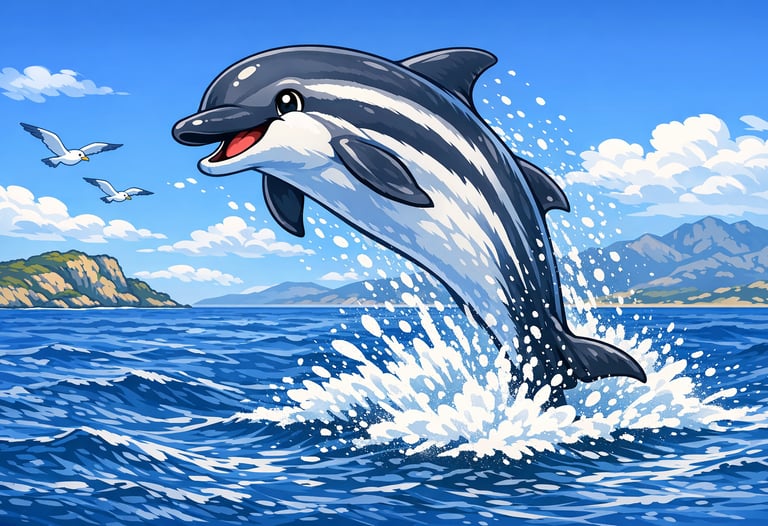
Now you are able to enjoy the full wonder of what you are actually seeing. There are at least ten, maybe twenty beautiful dolphins that are dark grey on top with a white belly and a really cool‑looking light grey stripe down their sides. And they are keeping up with the jet ski as they swim at the top of the water and hop out just like you’ve seen dolphins do on TV.
You enjoy the moment that seems to last a lifetime. Then you notice a boat getting close and you know the moment is about to end. Professor Wild starts to slow the jet ski down and something magical happens.
The dolphins start to jump out of the water.
You watch in amazement as the dolphins that were just swimming beside the jet skis are now doing flips and jumping well above you.
“Want to get closer?” Professor Wild asks holding four pairs of goggles in his hands.
“Can we really?” you ask with excitement, “Is it safe?”
“Sure it’s safe,” Professor Wild answers. “There has never been a dolphin attack in the wild. And there have only been a handful of dolphin attacks in captivity, and all of those were orcas. Hop in. Enjoy the moment.”
You take the goggles out of Professor Wild's hand with a huge smile on your face. You quickly put on the goggles and dive headfirst into the water. As your head pops out of the water you see a huge shadow over you. You look up to see the belly of a dolphin flying above you, then a moment later it lands feet in front of you.
You see a dolphin about ten feet away doing a back flip. Then something touches your leg. You look down to see a dolphin nudging your leg, and then diving down deep. Then a moment later that same dolphin comes flying out of the water at least two basketball goals in the air. When the dolphin finally lands you are hit with a huge wave and swallow some water.
Then as soon as it started, it was over. One by one the dolphins start to swim away. You try to see why they're swimming off but you see nothing but blue water.
As you climb back on the jet ski you ask Professor Wild "Why didn't you tell us about those animals while they were still here like you usually do?"
"Simple," Professor Wild tells you, "You should always enjoy the moment. The only difference is that with a lot of wildlife, it isn't safe to enjoy the moment with the animal itself."
"So what kind of dolphins were those?" you ask, "And what can you tell us about them other than they can jump really high and do flips?"
"Those were striped dolphins," Professor Wild tells you, "Clearly we aren't the most clever when it comes to naming dolphins. If you couldn't tell they get their name from that stripe on their side. I think I counted fifteen dolphins in that pod which isn't an unusual number but also isn't a large number. Their average pod size varies from region to region but in general, the average pod is between ten and thirty members. But they can get much bigger with pods being known to get to around five hundred individuals. They have also been known to create what we refer to as super-pods and those can get to around a thousand individuals. The reason we slowed down is because they swim around 25mph with some believing they can reach speeds up to 37mph for short bursts. And these dolphins love the deep water. Now we should probably make our way to the boat."
The jet ski starts back up and you ride the last couple of hundred feet to the boat where you are surprised to see two docking spots for the jet skis. Professor Wild parks in one and helps you onto the boat before guiding your dad into the other port.
Fun Facts
Striped dolphins can dive incredibly deep — sometimes over 2,000 feet — to chase squid and lanternfish that only come up at night.
They communicate with a mix of whistles, clicks, and burst‑pulsed sounds, and scientists think they may even have signature “names” like bottlenose dolphins.
Striped dolphins often travel with other species, especially common dolphins and pilot whales, forming huge mixed‑species groups in the open ocean.