
Secrets of the Everglades with Professor Wild - Part 1
Join Professor Wild on a hot, humid adventure through the Florida Everglades as he introduces you to one of the swamp’s most legendary creatures — the American Alligator. What starts as a simple boat ride quickly turns into a close‑up encounter full of surprises, fun facts, and a few heart‑pounding moments. Learn how these ancient reptiles survived near‑extinction, discover the hidden dangers lurking in the Everglades, and hold on tight as the tour heads toward the next mysterious animal waiting deeper in the swamp.
4/4/20266 min read
As you step out of the car the heat hits you immediately. Today is a very normal day in South Florida, a hot day in the 90's with humidity just as bad. You take a deep breath to take in the fresh air but instead, you get water up your nose because it's just that humid.
You walk over to the pier for your boat tour of the Florida Everglades when you see a familiar face in camo swim shorts, a blue button-down fishing shirt (only half buttoned), and an American flag cowboy hat.
"Professor Wild, is that you?" you shout at the man.
"Yes, it is. Good to see you again my dear child." The man replies.
"What are you doing here?" you ask "I thought you lived in Africa."
"Not quiet." Professor Wild replies, "Although, that would be more simple than the truth. I actually live here in Florida and work as a researcher here at a local University. As a researcher, I get to travel all over the world to study different animals, and if I'm lucky I might even discover an animal nobody has ever found before or maybe I'll be lucky enough to find an animal that science thought went extinct. It really is the best job in the world and I wouldn't trade it for anything. But I also do like to teach and I don't get that opportunity in my normal job so everywhere I go to do research I make sure to take at least one day to be a tour guide to teach others about the amazing animals that I get paid to love and learn about."
"Cool!" you reply as you run onto the pier.
"Walk!" you hear your mom yell from behind you.
"She's just worried for nothing." you think to yourself.
Next thing you know you are face down on the pier with your right sandal sticking up in between two wood planks in the pier.
"Are you okay?" your mom asks as she rushes over to you, more carefully than you were going.
"Yeah, I'm fine" you say trying not to blush from your embarrassment, at least none of your friends are here to see you fall.
As you get to the boat Professor Wild reaches out his hand to help your parents into the boat as he tells them "Watch your step." Then he holds his hand to help you into the boat as he tells you "She told you not to run."
"This is a weird boat" you say before you realize it. You look around at all of the blank stares from the adults in the boat and feel like you just said something stupid.
"This is called an airboat," Professor Wild explains "In the swamp, it's hard to know how deep the water is and some parts are extremely shallow. The mostly flat bottom of the hull keeps the boat from digging into the ground, and the giant fan on the back allows us to keep moving even when plants and mud would stop a normal boat engine."
"Alright everyone" Professor Wild addresses everyone "get in your seat and put on your hearing protection, this fan gets pretty loud." You head to an empty seat and put on the cheap-looking headphones.
You hear a huge roar as the fan starts up. You get pushed back into your seat and you feel the warm air in your hair as the boat moves forward for about the thirty seconds it takes to go to the other side of the narrow part of the swamp.
"We have made it to our first animal!" Professor Wild exclaims "If I'm being completely honest we could have started the tour from the pier but I really love driving the airboat."
You look behind you and see the pier still within swimming distance.
"Our first animal is an example of what is possible when we work together to save a species. This animal nearly went extinct due to people hunting them for fashion, and food but mostly fashion." Professor Wild explains "But due to conservation efforts that started in the 1960's this animal is off the endangered list and has a population of over a million in Florida alone."
"What are we here to see?" you ask with excitement as you look into the water.
"You're already looking at it." Professor Wild replies.
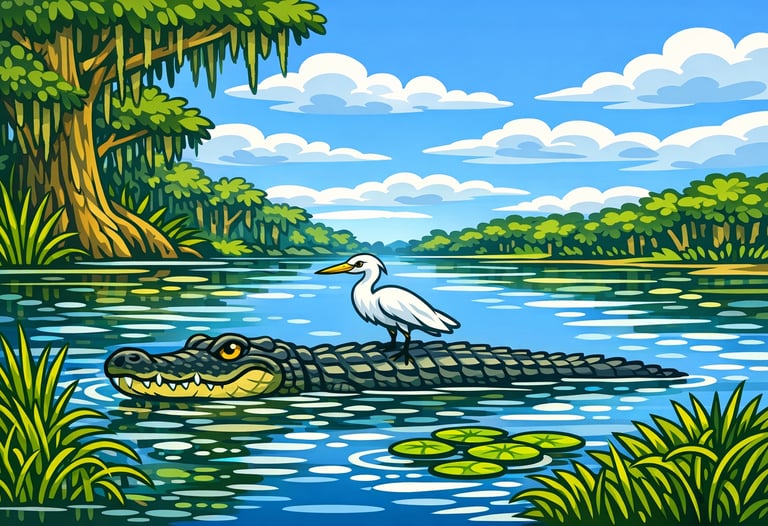
You look but all you see is a slimy log with a small bird on it.
"Are you going to tell us about that bird?" you ask slightly disappointed.
"Sure." Professor Wild replies "That bird is a Great Egret. They are a wading bird. Wading birds have long skinny feet that act like skis keeping them from sinking in the mud. These birds are excellent fishermen but also eat insects, fish, and lizards, small mammals like mice, and even baby alligators. They are about 3 feet tall with a wingspan over 4 feet. And like all birds, their bones are filled with air and a part of their respiratory system. Is there anything else you'd like to know?"
"Okay, that's kind of cool." you think to yourself. Then you see the bird fly away as the log suddenly turns to try to get it.
"What was that?" you shout.
"That is why we keep our hands and feet inside the boat at all times and away from the edge." Professor Wild replies with a grin on his face.
"You thought we came over here for the Great Egret didn't you" he asks.
"Not at first, but all I saw was the bird and a log, or at least I thought it was a log. What was that?"
"That is the native apex predator in this area." Professor Wild replies "The American Alligator. An animal that has reportedly gotten as big as 19 feet long. But that report was from the 1800's that the state record here in Florida is just over 14 feet."
"What do you mean native apex predator?" you ask confused as to why Professor Wild wouldn't just say apex predator.
"Because Florida is a little too relaxed in their pet laws." Professor Wild replies "As a result there are many invasive species here in Florida from the Everglades to the ocean. One of those invasive species is the Burmese Python. A snake that is native to Asia and can get to around 20 feet long with some claiming bigger. People thought they would make pets without realizing how big they get. Once their cute and small little pet started to get bigger than they thought it would get the people started to release them into the wild. Most people don't realize how delicate ecosystems are and figure if it's an animal that belongs in the wild than any wild should work. So now they are the biggest threat to alligators and the Everglades as a whole."
"So what are some other things you can tell us about alligators?" your dad asks.
"Some fun facts about aligators is that they have the third strongest recorded bite force on earth only behind their relatives the Nile Crocodile and the Salt Water Crocodile. It is also believed that the Great White Shark has a stronger bite force but that has not been able to be effectivley proven yet. Alligators live for a realitively long time. They typically live for 35 to 50 years but some experts believe they can live up to 100 years in the wild. Like other crocadilian species they go into a death roll when they are trying to tear apart their food or kill big prey. And babys are taken from their egg to the water in their mothers mouth where she will do her best to protect them."
"Where did it go?" you ask Professor Wild in awe.
"It's under the water. They can hold their breath for up to 30 minutes under normal conditions and up to 2 hours if they are completely relaxed. And, you'll find this interesting, if the weather gets too cold for them and it freezes they survive by leaving just their nose above the water and then slow their heart rate down 2 to 3 beats per minute almost like a self-induced coma to help them survive the conditions that they aren't supposed to be able to survive." Professor Wild replies.
"That's enough for now, I'm sure we'll see more alligators later. After all, they are all over the Everglades but now it's time to see more elusive animals."
You get into your seat and put on your headphones that Professor Wild called hearing protection. You hear the roar from the fan and are once again pushed into your seat as you set off for a longer trip to discover more animals.
Fun Facts
1. Alligators don’t chew their food — they swallow small prey whole and use powerful neck and jaw movements to gulp it down.
2. They have a special clear eyelid called a nictitating membrane that works like built‑in swimming goggles underwater.
3. Alligators can run surprisingly fast on land for short bursts, reaching speeds up to 11 miles per hour — but only in straight lines.