
Secrets of the Everglades with Professor Wild - Part2
When a massive creature bursts from the water and snatches a duck mid‑air, your quiet Everglades tour turns into a wild lesson in nature’s surprises. Professor Wild reveals that this isn’t an alligator at all—it’s the rare American Crocodile! As the airboat drifts through the swamp, you learn how to tell crocodiles and alligators apart, discover why the Everglades is the only place on Earth where they live side by side, and hear the incredible comeback story of a species once nearly extinct.
4/11/20264 min read
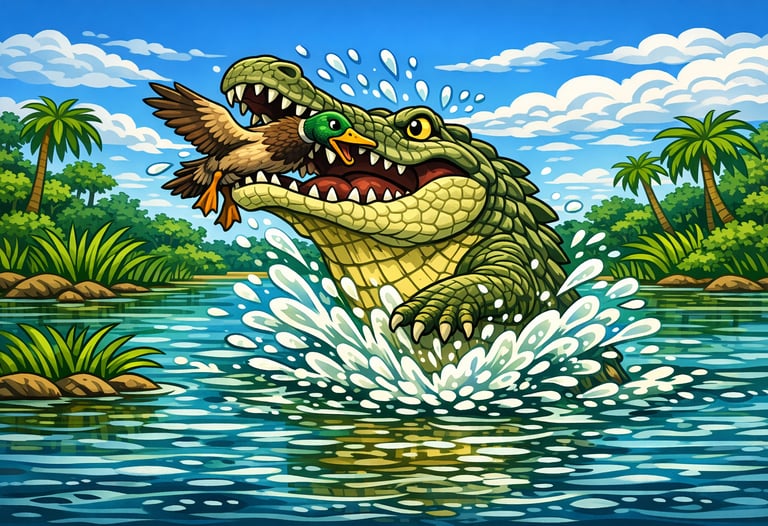
The boat slows down and you stare hard at the shore. For about five minutes you stare hard at the shoreline watching grass go by and nothing but grass. Then you reach a large pool area in the swamp and get distracted by some ducks swimming on the water.
You watch as all of the birds start to fly away. "Maybe they're scared of the boat," you think to yourself. But at that moment you see a massive animal shoot out of the water and catch one of the ducks out of the air.
"Did you guys see that Alligator?" you ask everyone in excited surprise.
"That wasn't an Alligator," Professor Wild corrects. "Although, I do see where you would think that. I even thought it when it first broke through the surface of the water, but then I got a better look. This animal is a close relative of the American Alligator but it is far more rare."
"Is this the elusive land animal you told us about? The one that we are on our way to see?" you ask eagerly waiting for the answer.
"No, this isn't what I had in mind," Professor Wild replies. "I don't know of any 'land animals' that can jump out of the water like that. But this is definitely a special enough animal to stop here and talk about it for a while."
"What is it!" your mom shouts. "Sorry, I know I should be more patient. But really, what is it?"
"That was an American Crocodile. I bet you didn't know we had crocodiles here in America, did you?" Professor Wild answers.
"No, I didn't," you all answer at the same time, stunned by the new information.
"If I'm being completely honest, there are a lot of similarities between American Alligators and American Crocodiles. But there are also some big differences as well as some subtle differences that help you tell them apart," Professor Wild continues.
"One of the similarities that might seem obvious is that they both live in the Florida Everglades. What makes this worth mentioning is that this is the only place on earth where Alligators and Crocodiles live together."
"That makes sense that this would be the only place for American Alligators and American Crocodiles to live together," you reply, thinking you're about to sound really smart. "But surely there are other places that have different alligator species and different crocodile species that live together, right?"
"No," Professor Wild replies while shaking his head. "I mean this is the only place on earth where an alligator and crocodile live together in the wild, regardless of subspecies. But since I'm on subspecies, this feels like a good time to tell you that crocodiles are naturally more aggressive than alligators. In fact, crocodiles are one of only four species on earth that are known to hunt humans for food. Don't be too worried, this is mostly the Nile and Saltwater subspecies that live in Africa and Australia."
"Well, that's slightly terrifying," your mom replies. "Is there anything else we should know that will keep me up at night?"
"None of this should keep you up at night," Professor Wild replies comfortingly. "But American Crocodiles, like other crocodiles, have glands that allow them to live in brackish water as well as salt water. They also have a large range, living in Florida, Mexico, other parts of Central America, and parts of South America. They mostly stay in swamps or brackish water, which is where freshwater mixes with the ocean's saltwater."
"So there must be a ton of American Crocodiles," you say.
"Not quite," Professor Wild replies. "While American Crocodiles do have a very large range, much larger than the American Alligator, which is only in the Southeast United States, the population isn't great. Their story is very similar to that of the alligator; like the alligator, their population has been climbing steadily since the 1970s, but not as rapidly as the alligators. You remember how I told you there were over one million alligators in Florida alone?"
"Yeah, I remember," you answer.
"Well, the American Crocodile has less than ten thousand adults in the entire world."
"That's terrible," you reply.
"Not really," Professor Wild assures. "This is still a great success story. They once had fewer than 300 in all of Florida, now they have around two thousand in Florida. That has taken them from the endangered list and on the brink of extinction to the threatened list which is a huge improvement."
"So how can we tell them apart?" you ask now realizing there is a difference.
"There are two easy ways to tell the two apart," Professor Wild explains. "The first is by the color, alligators are darker than crocodiles by a decent amount. This is how I was able to tell that it was a crocodile that jumped and not an alligator before it disappeared under the water. The second way is by their heads, alligators have a rounder head and crocodiles have a more pointed snout."
You stare hard at the water trying to see if you can get a glimpse of any other alligators or crocodiles so you can test your ability to spot the difference.
"Everyone put your hearing protection back on," Professor Wild yells. "It is time for us to continue our search for one of the most elusive land animals in all of North America."
Fun Facts
American Crocodiles can tolerate saltwater thanks to special salt‑removing glands on their tongues, which is why they’re often found in brackish or coastal areas.
They are surprisingly shy around people, especially compared to their more aggressive crocodile cousins like the Nile and Saltwater Crocodile.
American Crocodiles help keep the Everglades healthy by controlling fish and small animal populations, making them an important part of the ecosystem.