
Secrets of the Everglades with Professor Wild - Part3
The journey through the Everglades takes a surprising turn when a mysterious “house cat” turns out to be something far wilder. As Professor Wild leads the group deeper into the animal trail, they discover the truth about one of Florida’s stealthiest predators — the bobcat. Between laughter, lessons, and a race against nightfall, this chapter blends humor and discovery, showing how even the smallest creatures can be powerful hunters in the wild.
4/18/20266 min read
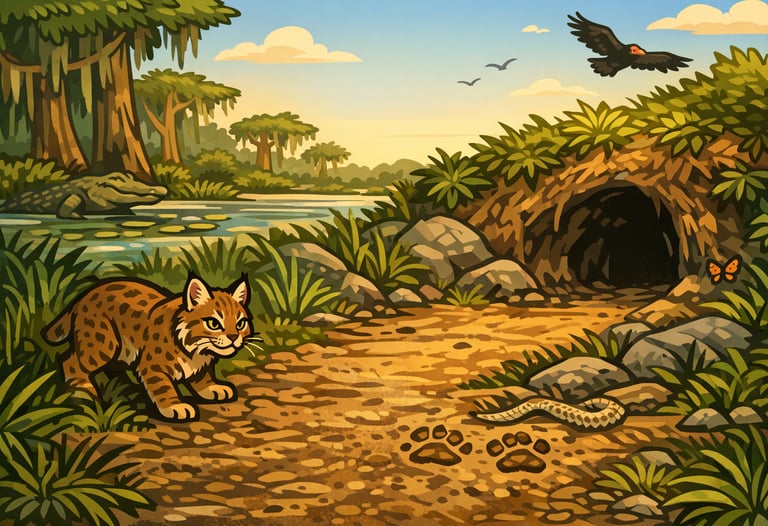
You hear the giant fan start back up as you are once again pushed back into your seat. You feel the wind hitting you in the face as you pick up speed. You watch as trees, bushes, and grass rush past you in a blur all blending into one.
You turn to look straight in front of the boat and notice that you are once again heading straight for land. "Professor Wild, I think we should stop, or at least turn!" You scream hoping to not go flying in the air again. "Don't worry my dear child," Professor Wild responds "I know exactly what I am doing."
You notice that Professor Wild has turned down the fan and the boat is now slowing down. But you're not slowing down fast enough to stop in time. "Buckle up!" you hear Professor Wild yell from behind. You hurry up and buckle your seatbelt that you just noticed for the first time. And just in time as the airboat hits the bank and slides up a few feet before coming to a stop.
You turn around to see Professor Wild's reaction but what you see is Professor Wild bending down to pick up a bag. "Alright everyone," Professor Wild says surprisingly calmly "Those sandals won't work for where we're about to go. Come and put on the pair of boots that are in your size."
You go over to the pile of boots sitting in the boat. You bend down to find a pair that already has your name on them with a pair of socks already inside. "Did you mean to crash?" You ask Professor Wild questioning the coincidence. "Who ever said we crashed?" Professor Wild asks in response "Didn't I tell you about why the bottom of an airboat is flat. One of the reasons we use them is so we can get to areas we wouldn't be able to get to without them and then we can park them on land."
As you put on your pair of boots you notice that Professor Wild is still barefoot. "Where are your boots?" you ask. "I don't need boots." Professor Wild boldly states, "I've been walking around in nature barefoot for so long that my feet don't react to most things that hurt your feet. I've also gotten extremely good at spotting danger and I am very careful about where I step."
Then you watch as Professor Wild looks off the front of the boat. "Watch where you step." He says right before he jumps off the front of the boat. You watch as he takes a few more steps in the shin‑high grass before he turns back to the boat and says, "Are you coming?"
You leave the boat first trying to perform the same jump that Professor Wild did but you land with too much speed and roll a few times before coming to a stop. You hurry to your feet and then quickly hurry to where Professor Wild is just in time to see your dad helping your mom off the boat.
Once your parents catch up you ask Professor Wild "Why did we leave the boat?" "Because it's hard to find an extremely elusive land animal in the water." He replies "I had you look while we were on the boat in case we got lucky but now it is time to try and find it on land but even here there are no guarantees."
Then Professor Wild turns and starts leading you up a steep embankment. When you reach the top you see a dirt road. "Why didn't we drive here?" you ask "I thought we needed the airboat to get to where we are." "We did need the airboat." Professor Wild replies "This isn't a man‑made dirt road that you might make to drive on. This is a path made from animals walking on it for years. This isn't a road at all for us humans. This is an animal trail that will lead us to the den of the animal we are searching for. But like I said, there are no guarantees. This animal has a very large range and there is no guarantee that it even lives at this den anymore."
Then Professor Wild heads down the trail as he yells back "Remember to watch where you are going. The Everglades have many native snakes in addition to the invasive ones, some of which are venomous and we aren't close to a hospital."
"Snakes? You didn't tell me there was going to be snakes!" You hear your mom yell at your dad from behind you. "I didn't think I needed to tell you there were snakes in Florida." You hear your dad reply in his shocked voice. You roll your eyes in embarrassment at the scene that your parents are making. You hear Professor Wild give a slight chuckle as he continues walking on the trail. "You won't find much of anything if you keep talking like that." Professor Wild advises. "Keep an eye out for any movement."
You immediately start looking in every direction you can think of. "What are we looking for?" you ask. "I've already told you." Professor Wild replies "We're looking for one of the most elusive land animals in North America. I guess one of the most elusive land animals in the Americas might be more accurate as it is native to all of North and South America. But you never know what else we might find if you keep an eye out for any movement."
You stare deep into the tree line and then you notice something. You see a brown house cat with pointy ears. "I think I see a cat." you whisper. "I see it too," your mom says as she bends down "Here kitty, kitty, kitty. Come here. You're okay. We aren't going to hurt you."
"That isn't what you think it is." Professor Wild tells you "Although, I completely understand the confusion. This is clearly a cat. It's slightly too big to be a house cat but is similar in size to larger house cats. And I've even known one to be friends with a large house cat, although that isn't normal."
"What kind of cat is it if it's not a house cat?" you ask. "It's a wild cat that is native to almost all of the United States as well as Southern Canada and Northern Mexico. But here in Florida this cat is native to every part of the state. Nationally, this cat has a range of 6 to 60 square miles. Here in Florida they tend to stay closer to the 6 mile range unless they live in a more urban area, then they have a smaller range of 1 or 2 miles."
"So I'm guessing this is a baby then if it's this small and is a wild cat?" your mom asks concerned for the cat. "Not at all," Professor Wild replies "This looks to be a fully grown Bobcat. They range in size from 9 pounds to 33 pounds depending on where they live but like all cats they are amazing hunters and can thrive almost anywhere as long as there isn't too much human interaction. But these little guys have been known to take down prey as big as deer in certain areas. That is what makes house cats such a problem for most ecosystems. They have shelter and food but they are natural hunters who will hunt for fun if they don't have to hunt for food."
"This little thing can do all that?" you ask in amazement. "Yeah, this 'little thing' is one of the top predators in the Everglades. It might not be as big and scary as the Alligator, Crocodile, or what we're looking for but it is still one of the top predators."
You look intently at the animal you now know is a Bobcat and not a house cat. "We better keep on moving if we're going to make it to the den that I know of and make it back before nightfall." Professor Wild says as you continue your journey down the bug‑infested dirt road.
Fun Facts
Bobcats have super‑powered back legs.
Their back legs are longer than their front legs, which helps them leap up to 10 feet in a single jump.
Bobcats almost never meow — they scream, hiss, and yowl.
Some of their calls sound so strange that people sometimes mistake them for ghosts or mountain lions at night.
Bobcats are nighttime ninjas.
They do most of their hunting at dawn and dusk, using their incredible night vision to sneak up on prey without being seen.