
Secrets of the Everglades with Professor Wild - Part4
Join Professor Wild and your family on a long, mosquito-filled trek deep into the Everglades in search of one of North America’s most mysterious animals. After discovering an abandoned den, fresh tracks, and miles of empty wilderness, it seems like the adventure might end in disappointment — until nature delivers a breathtaking surprise at the very last moment. This unforgettable journey blends patience, discovery, and a once‑in‑a‑lifetime encounter with the elusive Florida Panther.
4/24/20267 min read
“How much longer?” you ask, tired from walking for what seems like forever. “It’s just before that turn up ahead.” Professor Wild tells you. “Will you tell us what we’re looking for?” you ask, not having the same patience you normally have with Professor Wild because your legs are getting tired.
Professor Wild turns to look at you and then reaches into his bag. “Here, drink up. Sometimes I forget how far most people can go before they start to get tired.” He says as he pulls out insulated water bottles for everyone. You take it and take a few gulps of the ice-cold water.
Once you quench your thirst, you hand the half-empty water bottle back to Professor Wild. “Is everyone ready for the last hundred feet?” he asks. “I could have waited a hundred feet for water,” you think to yourself, as you follow Professor Wild the last hundred feet.
“We’ve made it,” Professor Wild whispers, “I just hope she’s here.” “Wait. She might not even be here?” you ask Professor Wild. “I told you that there was no guarantee that this den was being used anymore.” He says as he starts carefully heading into the treeline.
You follow right behind until Professor Wild tells you, “Wait here for a moment and let me check it out first.” You stop where you are still watching Professor Wild closely as he walks through the thick trees to a small clearing with some grass that has been flattened.
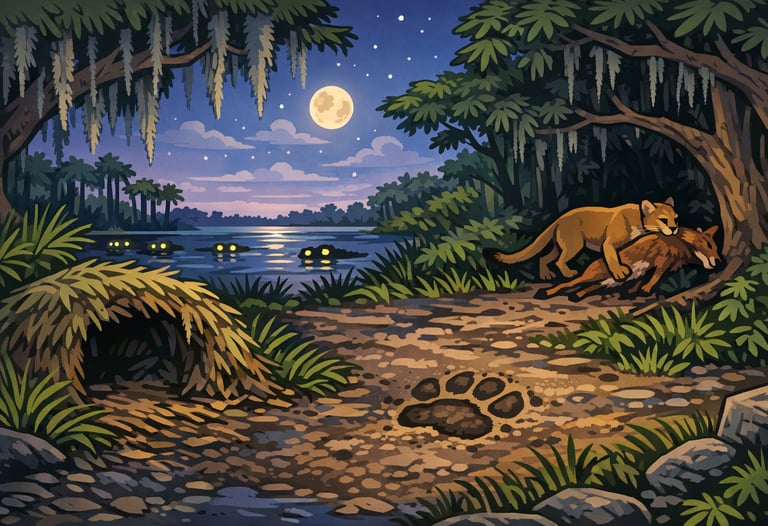
“You can come here,” Professor Wild tells you. You walk to the small clearing where Professor Wild is and realize that something turned that grass into a bed. “Where are we?” you ask. “This is an abandoned den of the mystery animal that we are looking for.” Professor Wild tells you, “Similar to the Bobcats, this animal has a large range, so they use temporary dens instead of permanent ones. I know this animal had been here and was hoping it might still be staying here, but this den has been abandoned for at least a couple of days.”
“So what do we do now?” you ask, disappointed. “We head back,” Professor Wild tells you. “Hopefully, we will see it before we get back to the parking lot. Or hopefully, we will find another animal that we can talk about to take its place, but if we don’t, I’ll tell you all about the animal we’re currently trying to find.”
You head back to the trail to start your walk back to the boat. “Keep an eye out for anything that looks strange, make sure to pay close attention to the trees,” Professor Wild advises you.
As you look intently at the environment around you, you notice something you haven’t seen before. “Professor Wild. What is that?” you ask, pointing to the ground where you see the print of something large. You bend down to put your hand over it and notice that this paw print is the size of your hand. You see that whatever made this has four toes to go with the foot.
“What does it look like?” Professor Wild asks. “It looks like the print my dog makes when it steps in mud, only this is much bigger,” you answer. “That is pretty much what this is,” Professor Wild replies, “This is the paw print of our mystery animal, and yes, I am almost certain it is bigger than your dog, but that does depend on what kind of dog you have.”
“I have a chihuahua,” you tell him. “Then this animal is definitely bigger than your dog. So much so that I’m not even sure your dog would count as a snack for this animal.” Professor Wild tells you.
“So this means that we’re close, right?” you ask Professor Wild hopefully. “It definitely means that this animal was here not too long ago, probably two days max,” he replies, “Unfortunately, that doesn’t mean that it is close as this animal can travel between 15 and 20 miles a day. Meaning that if this print is two days old, this animal could be up to 40 miles away. At the same time, it could be watching us as we speak without us even knowing.”
You follow Professor Wild down the path, no longer knowing how to feel. You feel disappointed knowing that you might not get to see the animal that Professor Wild has been so excited about. At the same time, you feel hopeful that you might be able to see an animal that so few people get to see at any moment.
You stay focused as you walk down the trail. You scan the branches above you, then you look closely at the water's edge, then you look at the dirt trail to see if you can find anymore paw prints, then you look hard into the treeline where you found the bobcat.
But for mile after mile, you see no sign of life, other than the bugs that keep flying around you, the worst of all being the mosquitoes that won’t stop biting you.
“Drink up.” Professor Wild tells you as you reach the boat. You take the bottle without saying anything. You’re hot, sweety, thirsty, itchy from the mosquitoes, and sore from the long walk, not to mention disappointed from not seeing the animal.
Once you finish your water, you tell Professor Wild. “I really thought we were going to find it. Why did we fail?” “We haven’t failed,” Professor Wild says in a comforting voice, “For one thing, we are still on our journey and very well might find the animal we are looking for. For another, no matter how experienced you are, you never know what you will or will not find in the wild. Outside of some very common bugs, nature is unpredictable, and what makes it all worth it is the journey, what you do find, and what you learn along the way. Plus, every true adventurer loves these quiet moments, the moments when it’s just you or your group and the water or sunset or mountaintops and you just get a chance to breathe.”
You look out at the water and watch the sun as it gets closer to setting, and you just think about what Professor Wild just said. “I guess we didn’t fail,” you think to yourself, “I still got to learn about new animals, experience the Everglades, even if I could have done without the bugs, and see some animals we weren’t planning on seeing.”
“Everyone to your seats,” you hear Professor Wild say, interrupting your quiet time. “We have to get moving if we’re going to get back by nightfall.”
You get into your seat, put on your hearing protection, and watch your parents get into their seats. Then you watch as Professor Wild hops back off the front of the boat. He puts both of his hands on the boat and starts to push. You start moving backwards slowly until the boat is almost entirely in the water. Then Professor Wild jumps onto the boat and goes to his seat, where he turns the fan back on.
This time, you aren’t forced into your seat. Instead, the boat starts going backwards and turning. Then you hear Professor Wild move something, and the boat lunges forward with the normal power you have come to expect.
You start heading back to the pier at full speed. You see the colors of the trees, grass, and bushes you're passing, but you're going too fast to tell what they are. You see hundreds, if not thousands, of eyeballs in the water and wonder if they are alligators, crocodiles, or perhaps turtles, or maybe something else entirely that you don’t know about.
You buckle up your seat belt as you remember the jump that you made earlier. Just in time to avoid going flying and crashing into the water like the boat.
As you near the pier, you have a huge smile on your face from the boat ride that belongs in an amusement park.
The sun has completely gone down by the time you reach the pier, and now Professor Wild is using a big flashlight to see. As you start your final approach, something catches Professor Wild’s eye. You look at where he has just shined you light and see a deer about 50 feet away from your car.
“Careful driving back,” Professor Wild tells your dad, “It looks like the white-tailed deer are out.” At that moment, you see something fall out of the tree and land on the deer. The deer panics for a second and then is still. Now that it isn’t moving, you see that the thing that fell is a huge brown cat.
“Everyone, I’d like to introduce you to the elusive creature we have been looking for,” Professor Wild states with a huge smile on his face, “This magnificent animal is the Florida Panther, also known as a panther, mountain lion, or cougar, they’re all the same animal. This is the largest cat in all of the United States and Canada. As well as the second-largest cat in all of the Americas. These cats can weigh anywhere between 64 and 220 pounds, depending on if they are male or female and where they are located. These animals are native to almost all of North and South America, although due to hunting and habitat loss, they are mostly found in the western part of Canada, the U.S., and Mexico. With a small population in Florida, obviously.”
“Are these as dangerous as people say?” your mom asks nervously, with it being so close to the car. “Not even close,” Professor Wild replies, “These are solitaire animals, meaning if they get injured, they can’t hunt and will usually die. Humans are around the same size or bigger than mountain lions, so we pose a decent injury risk, unlike grizzlies and polar bears, which are too big for us to really pose any threat. Therefore, they only attack when they are really desperate. On average, there are 4 to 6 mountain lion attacks on people a year in all of the U.S. and Canada combined. With only one fatal attack every 5 or so years. You have a much higher chance of dying by falling down stairs than you have of even being attacked by a mountain lion.”
You all sit there quietly in awe of this amazing animal and this once-in-a-lifetime experience. Once the cat has eaten enough, you watch as it drags the deer into the treeline. Professor Wild tells you, “It is going to store the rest of the deer for later. It will find a nice spot and cover it with some leaves to hide it from scavengers.”
Then Professor Wild docks the boat at the pier, and you and your parents get back in your car and talk about your adventure all the way home.
Fun Facts
Mountain lions can jump farther than any other mammal in North America.
They can leap forward up to 40 feet in a single bound — that’s longer than a school bus.
Mountain lions don’t roar — they purr.
They can also chirp, whistle, growl, and even scream, but they can’t roar like lions or tigers.
Mountain lions have the biggest territory of any land animal in the Americas.
A single adult can roam an area of 150 square miles or more, depending on food and space.