
When Grace Meets Shame
This narrative places you in the shoes of the Samaritan woman who believes she is unlovable. Through her eyes, you witness the moment Jesus breaks cultural barriers, speaks to her deepest wounds, and offers her a new beginning. A powerful reminder that no one is beyond God’s reach.
3/13/20265 min read
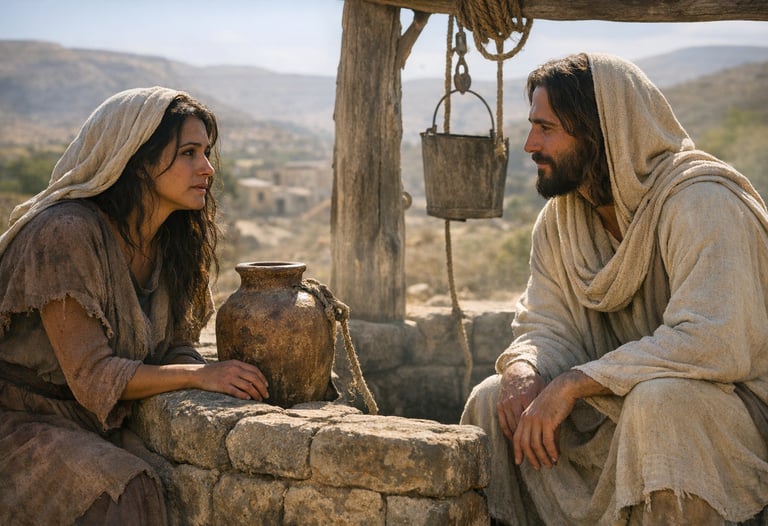
You are a Samaritan woman. You don’t like Jews, and Jews don’t like you. Jesus is a Jewish Rabbi, and Rabbis don’t talk to women or Samaritans.
You are ashamed. You have made too many mistakes in life, and that is why you know that you are unlovable. You live in a time period when the meaning of life for a woman was to get a husband and have kids. You are good at that first part but not the second. One by one, each of your husbands has decided that you weren’t good enough for them, that you weren’t worth their love. Now, after being abandoned five times, you believe them. You believe the town. You have been shown time after time that you aren’t worth anyone’s love. You have given up on love, and now you settle for living with someone just so you aren’t completely alone. But you feel alone. You’re an outcast that everyone makes fun of when they see you. That is you, and that is where our story begins.
You get up later than all of the other women in town. You know that you should go and get the house some water, but you know that they will be there. You can handle the comments you get from guys, but something about the way the women gossip about you — you just can’t stand it. So you stay and clean up the house for a bit. It should have been done last night, and as a result people think you’re lazy, but it’s more than that — you’re protecting yourself. After you finish the most thorough cleaning you can to waste as much time as possible, you go out to the town well. It’s about noon now, the hottest time of the day. Surely everyone has already gotten their water for the day. And that is just how you like it — just a few minutes for you to be completely alone. No stares, no rude remarks, your chance for some peace and quiet.
But this day, you apparently didn’t come late enough. When you get to the well, you see a man there. You think to yourself, Does he know who I am? Does he know the things that I have done? Does he know the reputation that I have? What does he think of me? I hope he doesn’t say anything to me. I can handle the stares from men, but it’s the remarks I truly hate. As you get closer to the well, you keep your head down. It’s bad enough that your quiet time has been interrupted — you really don’t want a conversation. As you start to get some water, the man turns to you and asks you to give him some water. You recognize his accent. You know there is no way he knows your story because he is a Jew who doesn’t belong here. You also know the way to get him to end the conversation right then and there. You reply to him, “How is it that you, a Jew, ask for a drink from me, a woman of Samaria?” You know that if you say that with enough attitude, nobody will want to keep talking.
Despite your best efforts, this conversation isn’t ending. Instead, it is just getting started. The man responds to you, “If you knew who it was that asks for a drink, you would ask him for a drink, and he would give you living water.” You think to yourself, Great, this guy talks in third person. What kind of person talks in third person? Then you start to look him over and notice that he doesn’t even have anything to get water with, and now he is offering you water. You get a slight grin on your face as you answer him in a slightly sarcastic tone, “You have nothing to draw water with, and the well is deep. Where do you get that living water?” The man simply responds as if he didn’t even notice your tone: “Everyone who drinks of this water will be thirsty again, but whoever drinks of the water that I will give him will never be thirsty again.” This guy is weird, but you are so tired of planning your day around not seeing anyone at the well that you decide to give in and ask him to give you that living water.
When you ask him this, he tells you to get your husband. This isn’t good. He has just brought up your greatest hurt. Holding back tears, you tell him that you don’t have a husband. You think that you have just avoided the worst part of your secret from coming out — until the man replies, “You are right in saying, ‘I have no husband’; for you have had five husbands, and the one you now have is not your husband. What you have said is true.” Your heart drops, and you can no longer hold back the tears. You have just been called out by this man you have never met. You think to yourself that this man must be a prophet. How else would he know this? You don’t tell anyone your past.
Trying to sound spiritual to redeem yourself, you ask him where the correct place to worship is, because the Jews and the Samaritans both have their own place they think is correct. But the man gives you an answer you didn’t expect. He tells you that “the time is coming when it doesn’t matter where you worship. God is spirit, and those who worship him must worship in spirit and truth.” Still trying to sound spiritual, you tell the man, “I know that Messiah is coming. When he comes, he will tell us all things.” Then the man tells you something you are already thinking: “I who speak to you am he.”
At this, you forget what you came to the well to do, and you leave toward the town, forgetting your water jug. When you get back into the town, you are no longer afraid of what people think of you. Instead, you go up to everyone you see and tell them, “Come, see a man who told me all that I ever did. Can this be the Christ?” As soon as you get done telling one person, you go up to another, and as you are telling people, you begin to notice that those you have told are heading to the well. As the day passes and you continue to tell others, you notice that Jesus is staying in the town — and that he does so for two whole days. When Jesus finally leaves, people start coming to you and telling you that they no longer believe because of what you told them, but because they have heard for themselves and know that he is the Savior of the world.